A Nicer Way to Travel
I
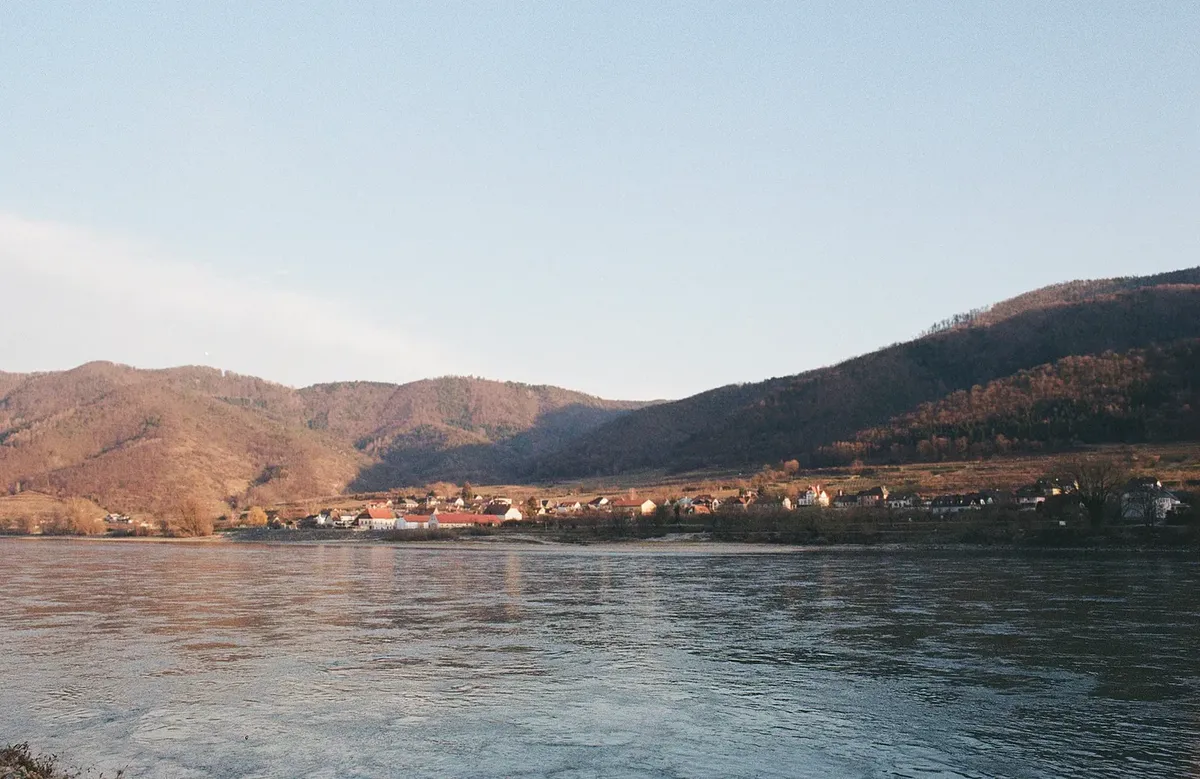
Downstream of Melk the Danube wanders wide and shallow through perhaps the greatest wine-growing region in Austria. There is a path along the riverside, and there are castles on the hills, and villages every so often.
In the old days the aged wines, considered the best, were sent to royalty and so the people in the villages would drink the young stuff. The fresh wine is served seasonally at heurigen, small cozy living room-style restaurants opened by wineries for a few weeks at a time.
On the bike path down the river we pass many castles, as you do in Austria, and we have no clue who built them or what they were used for. That’s okay. It isn’t as though you need to know everything about everywhere you visit. Sometimes it’s more fun to guess. Maybe your own story is better than the real one.
At one point we come across an avalanche. We consider climbing over except that they are doing work on the avalanche. The official detour would take us way out of the valley. Just then a local defies the stereotype about unfriendly Austrians and gives us directions to a path nearby. An hour later we find ourselves descending a steep winter forest, carpet of leaves, down towards Aggsbach and the river.
It is almost dark by the time Kevin and I bike into a small village where, according to some locals we had met, there is an open heurigen.
“Are you sure it’s open?” The village could not look less open.
“I don’t know, it’s supposed to be right around the corner.”
Around the corner, indeed, you can start to hear the sounds. Glasses clinking. Laughter. We timidly ask if there was a table for two, which there is, and it is the last table, in a little corner, which we can have so long as we leave within two hours, when another group has reserved it. The furniture is light wood and there are paintings on the walls and low, warm light. When we ask about an unfamiliar item on the menu, the waiter (and owner) walks us back into the kitchen to show us.
Everything is cheap and good.
We bike back in the dark, wine-drunk, and barely catch the train.
II
Before the flight to Vienna I saw an ad on Instagram from Figlmüller, one of the more famous Austrian restaurants in Vienna, at least with tourists. The caption on the ad said something like: In an age of modernity, embrace tradition. A couple of young men were clinking wine glasses over plates of schnitzel. That’s okay I guess, and I ate schnitzel too, but dining in these old European capitals does not have to be all that.
On the night I arrive it is late, especially for Austrians. Kevin and I walk to where the street stands are open; we order currywurst and then kasekrainer (a sausage with molten cheese inside) at two separate stands. I can see my breath in between bites.
“More curry ketchup?” Kevin asks at the first stop.
We find ourself at sausage stands maybe five times during the few days I’m in Vienna. And that is not to mention the other street food, like at the Berlin-style döner stand that works so fast we have it in our hands before we even have a chance to pay.
At no point on the trip do I make it to Figlmüller, or to most of the restaurants you might find in one of those tourist guidebooks or on a travel show. We don’t eat street food the entire trip of course, and on a couple of occasions we stop in to have classic Austrian fare at classic-looking Austrian restaurants.
The fancy traditional food is good. Kasekrainer is better.
III
The idea that you should experience a city like a local is a bit silly, because what locals do is work. They are not trying to have the best day of all time in their city, day after day after day. Usually I abide by that sentiment and don’t mind being a capital-T tourist, taking photos, walking around to see the famous things with all the other tourists. There is no moral victory in not taking the photo, or not going to the place, because that’s what other tourists are doing. After all you are a tourist, too.
But sometimes the locals know what they are doing. In Vienna they go to cafés a lot. And unlike in some some other parts of the world (ahem), in Vienna most people don’t go to a café for a quick bite or a to-go coffee with a 25% tip on the iPad screen. They go for hours, to chat, to read, to work, to read the newspapers that most cafés have neatly set out for you to peruse. It’s nice.
Kevin and I spend a ridiculous amount of time in these cafes. We visit close to ten during the few days I am there. We do this, of course, in lieu of speedrunning the city, seeing all the museums, going to all the monuments. Drinking coffee in comfortable surrounds (oh no, I’m sounding like the summaries on Google Maps) is a justifiable way to vacation. Even if it’s all you do.
“After lunch…”
”Yes. Another café.”
At Prückel we order the famous sacher cake with apricot jelly. At Jelinek I spend more than 10 euros on coffee. At Ministerium I say the schnitzel is better than at the Meierei, which they do not believe. At Eiles we try 8 times before we can get the waiter’s attention for the bill [1]. At Ritter a dog leaves enough hair on my coat for me to sew together another one. At Wortner we comment on the nice wood paneling, blissfully unaware that 20 minutes later we’d be biking full speed to catch a train.
You can pass the day like this in Vienna in a way you cannot almost anywhere else.
There is sometimes this idea that you need to ‘do’ a city, you know, to see all the ‘must-see’ spots and to make sure you can come home and nod your head to say: Yes, I saw the palace, and Yes, I saw the famous art thing, and Yes, I saw the famous statue thing, and Yes, I saw the famous historical place. You can do that. I do that a lot.
But if I had spent all my time doing Vienna, I would not have had such a great time being in Vienna; sitting in all of its cafés, drinking from wine taverns on the Danube, ordering hot cheese sausages from its street food stands. It’s true, there is no correct way to get to know a place. But I am happy about the way I met Vienna and the Austrian countryside.
[1] pretty good service, by European standards