My Big Adventure Up the Mountain
I’ll begin with a warning. The title of this essay is not a poetic metaphor for my emotional journey up a fake mountain. This is about my big adventure up a big mountain. A real mountain. (And a big one!)
It is basically a little story about the most difficult walk I have done in my entire life.
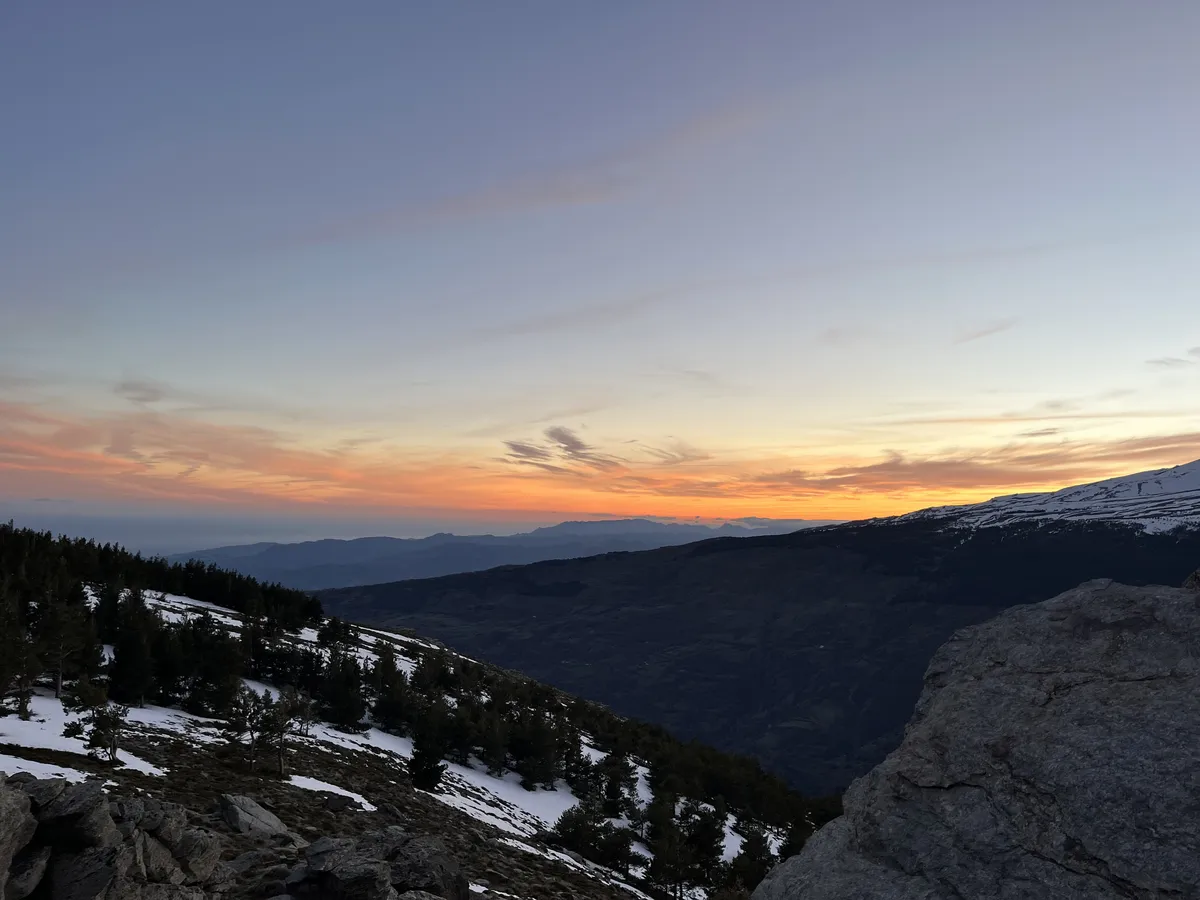
Mulhacén is the tallest mountain on the Iberian Peninsula. It is 11,410 feet tall. As a result of this “tallest mountain” fame and its location as one of the only true mountains in southern Spain, it is popular. There are hiking clubs just for Mulhacén.
The most classic route up Mulhacén starts approximately 7 miles from the summit, in a small parking lot. You climb a steep path up, gaining thousands of feet until you reach the top. Some people go up and down in a day. Others overnight. It is rated on Alltrails and Komoot as a “hard hike,” with “very good fitness required.”
I wanted something different. And so scrolling Google Maps one evening I realized: Mulhacén is very close to the ocean. So: what if I started on the beach?
The total distance of the route I mapped out was about 45 miles with 15,000 feet of cumulative elevation gain. And so I asked myself another question:
What if I hiked this in one day?
1. Chased by Dogs
It was cold and dark and rocky on the beach, and I felt sick. The night before a group of low budget holiday-makers had arrived to the small hotel. Cheap old construction being what it is, I heard their shouting and screaming and the clanging of pans in the kitchen until 2 in the morning. This would be annoying in any circumstance, but it was especially annoying as I set off at 3:30.
You do not need to talk to a sports scientist to know that one-and-a-half hours of sleep before attempting the most difficult physical feat of your life is not a recipe for success. But whatever. What was I supposed to do?
Later I would realize that I did not even walk to touch the ocean before starting. (This had been a plan of mine.) But whatever. How was I supposed to remember?
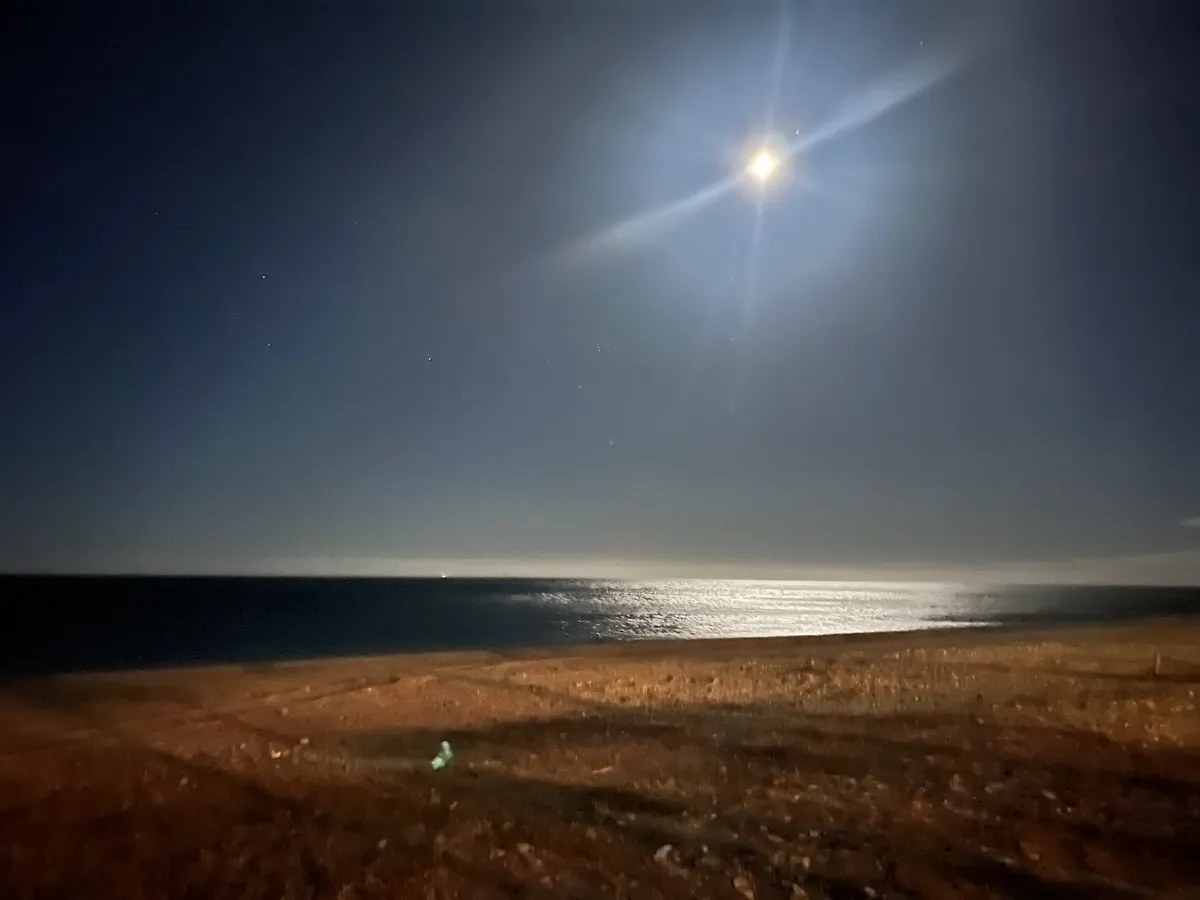
The streets in Castell de Ferro were quiet and I was walking straight into a cold sharp wind. I began by following a narrow paved service road along some kind of dry riverbed. When I traced the riverbed upstream with my eyes I could see how it wound up and then disappeared into the first series of mountains I would be climbing; dark masses on the horizon only decorated by a handful of lights flickering like lanterns, marking where the villages were. I turned my headlamp off and relied on my eyes and the ambient light. I did not want to be making a scene quite so early.
If you looked at these hills during the daytime it would appear as though they were covered with an ugly silver blanket; those would be all the roofs of the greenhouses. This was a problem for hiking, of course, because there were no actual trails.
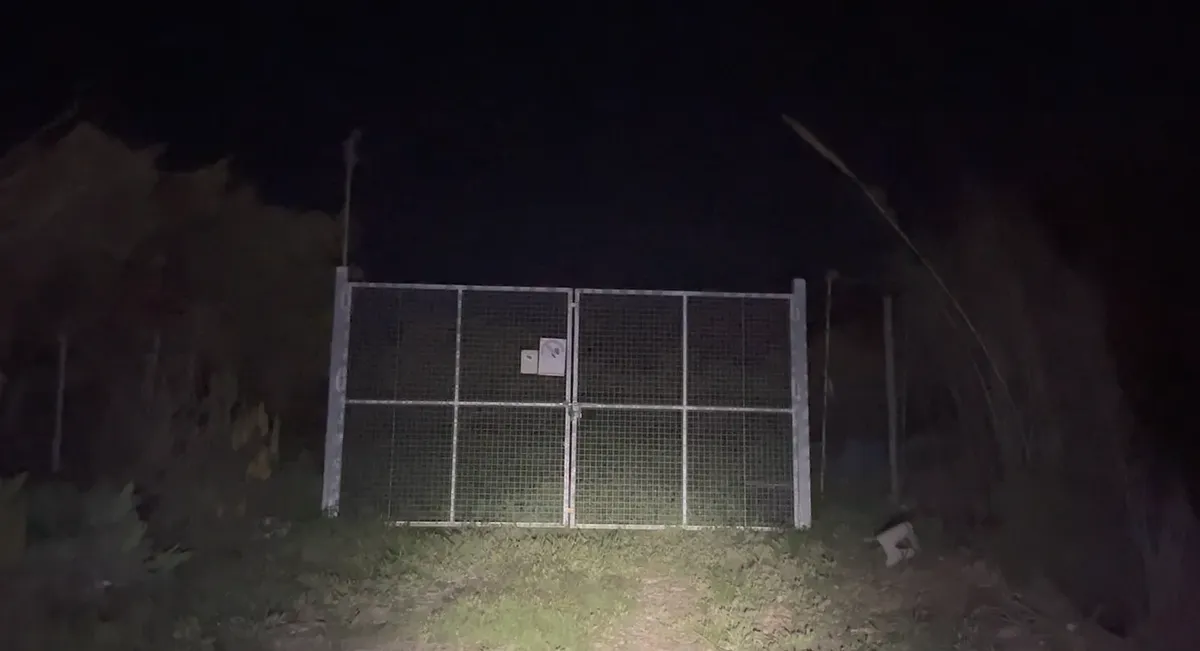
Only a few miles in, already sweating and still navigating by headlamp, I came across my first obstacle on the route: a tall gate with a “no entry” sign. This was a bigger-than-average wall. So there I was, 4:00 in the morning, scrolling on my phone to figure out if the whole trip was over already. It wasn’t. I found my way around. The first stretch of the hike was littered with these improvisations and walls and greenhouses.
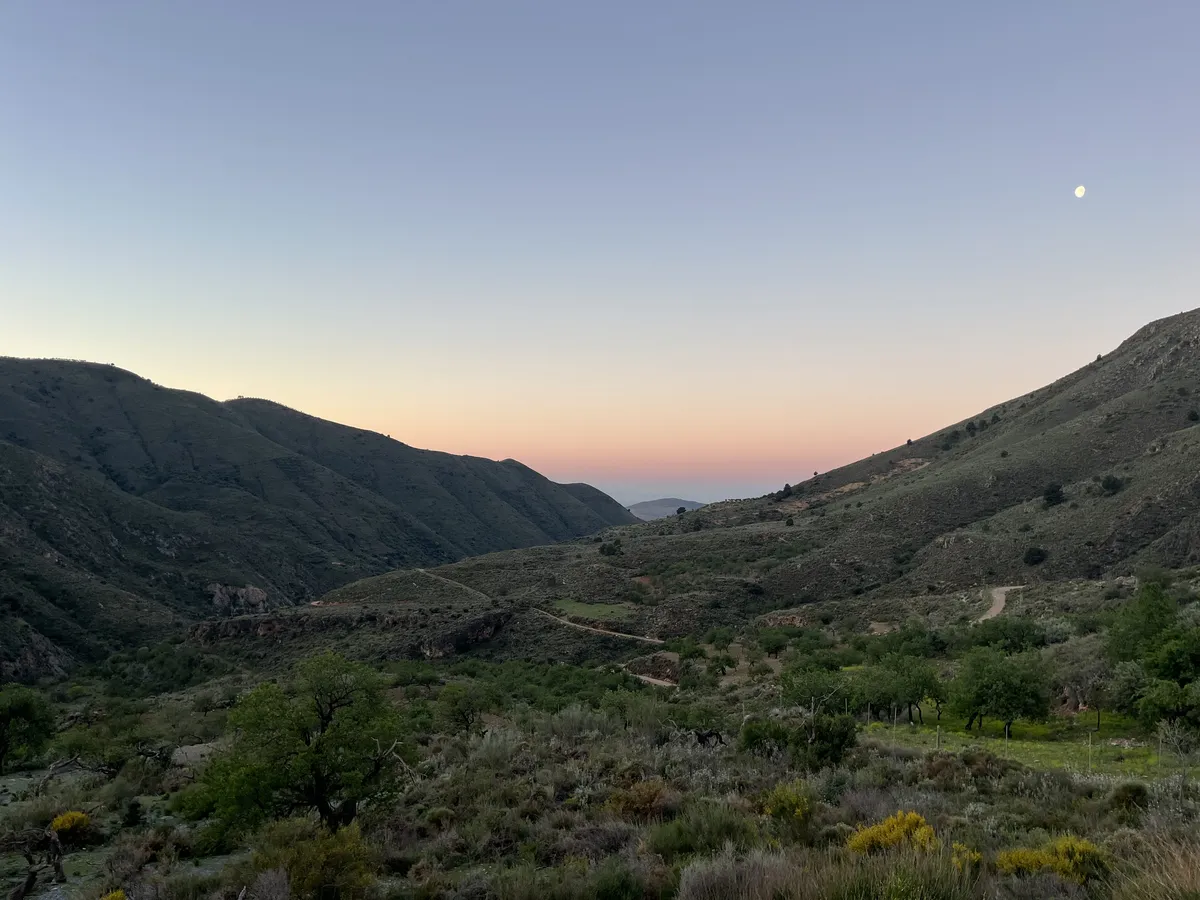
Service road became dirt trail became road again, which I followed as it snaked back-and-forth in helpful switchbacks up the series of hills. The sun rose and painted the hills first pink and then red and then golden. I could finally see without the headlamp. Everything was good with the world and I was going to make it to the top of the damn mountain, like it or not. Mission: Soon to be Successful.
That was when I heard the dogs. You have to be careful in these forgotten corners of Spain, and in Europe. There are dogs and it is not clear who they belong to or why they are there. When I saw them they had come hurtling out of the bushes on the side of the little highway. Why were they in the bushes? There wasn’t a house for miles. Why were they hurtling at me? I have no idea. What were they guarding?
Having had negative experiences with random dogs like these on other hikes I thought fuck the road and made it straight up the hill, pushing my way through brush and feeling all the spidery branches draw blood, and I made it to the next village.
. . .
Did anyone live here? It was not clear. The few houses I had passed on the way up had been empty; the village was dead quiet even though the sun was well up. I peered into the white-painted houses and saw empty living rooms, sofas covered with dust tarps. I had thought that I may find some kind of refuge here but somehow I felt worse in the village than I had on the highway.
It is one thing to be alone when you are supposed to be alone, in the wilderness. It is another thing to be alone when you shouldn’t be.
I saw the first person of the hike about an hour later, just as I was coming the top of the first mountain range and could see a wide green valley ahead of me. The man was standing in front of the only building I could see. He was looking at the door.
“Morning!” I said.
He looked up. “Morning.”
“Sorry to bother you - but do you happen to know if there is water in that building?” Just a few hours in, I had run dry.
“Sure, I can give you some. Come inside.” He pulled out a fat keyring from his belt and I realized that he must be the owner of the hotel.
“How’s business?”
“I’m closing,” he said. “The hotel is not opening again.”
“Why?”
“Retiring,” he said as he pulled a big jug out and started pouring into my water bottle.
It was one of those classic interiors. Everything wooden, old lamps, comfortable furniture in places, a fireplace. Sun was just starting to come through the ocean-facing windows. In other circumstances I would have loved to stay here.
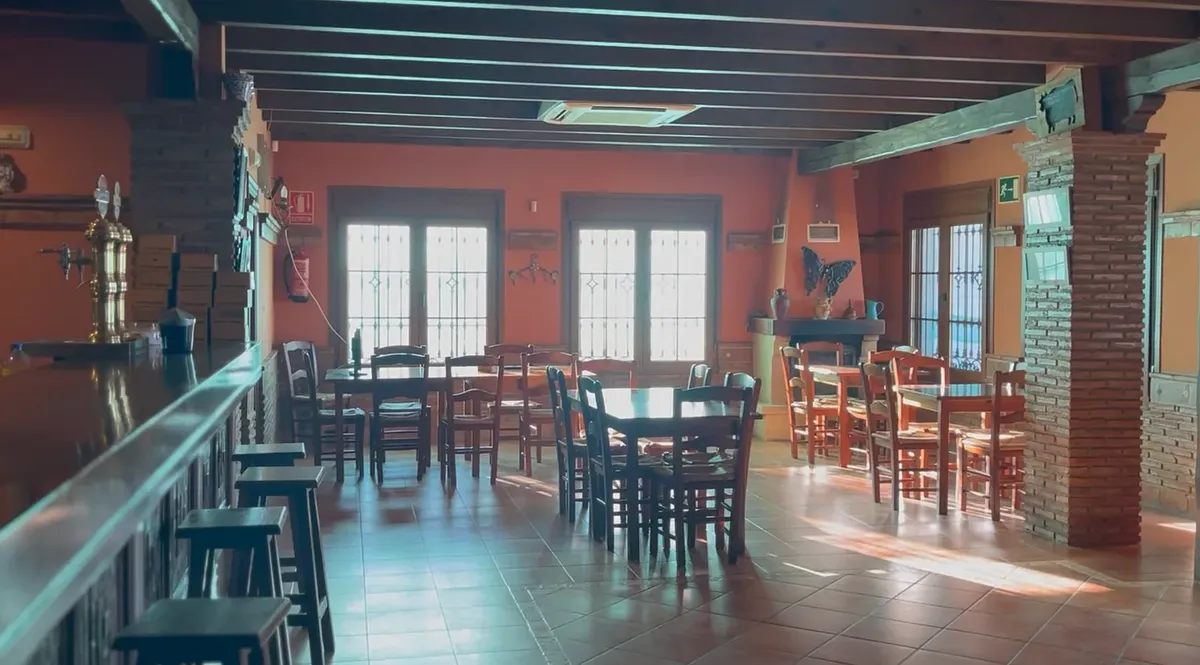
“There you are,” he said.
“Well, thank you so much. The hotel is nice,” I said. It had begun to dawn on me that I may be the last guest to ever visit the hotel. When he locked up again maybe it would be for the last time. “By the way - do a lot of people hike around here?”
“Yes, they do. Some.”
“Do they ever hike from here to Mulhacén?”
A strange look. “No. It’s really far.”
“Ah. Hm, okay. Thank you again for the water.”
2. Into the foothills
It was a glorious day to be hiking. The sky was the kind of deep blue you only get in the mountains and in those other far-away places where the air is still clean. I had gone through a few liters of water and some energy jellies and some candy, and I was sweating, and sure, my legs hurt. But they hurt in the normal way they do when you hike, and I knew there was a lot left. And I would need a lot.
Coming down into the valley from the first mountain range I was met with the most glorious view of all: the mountain Mulhacén.
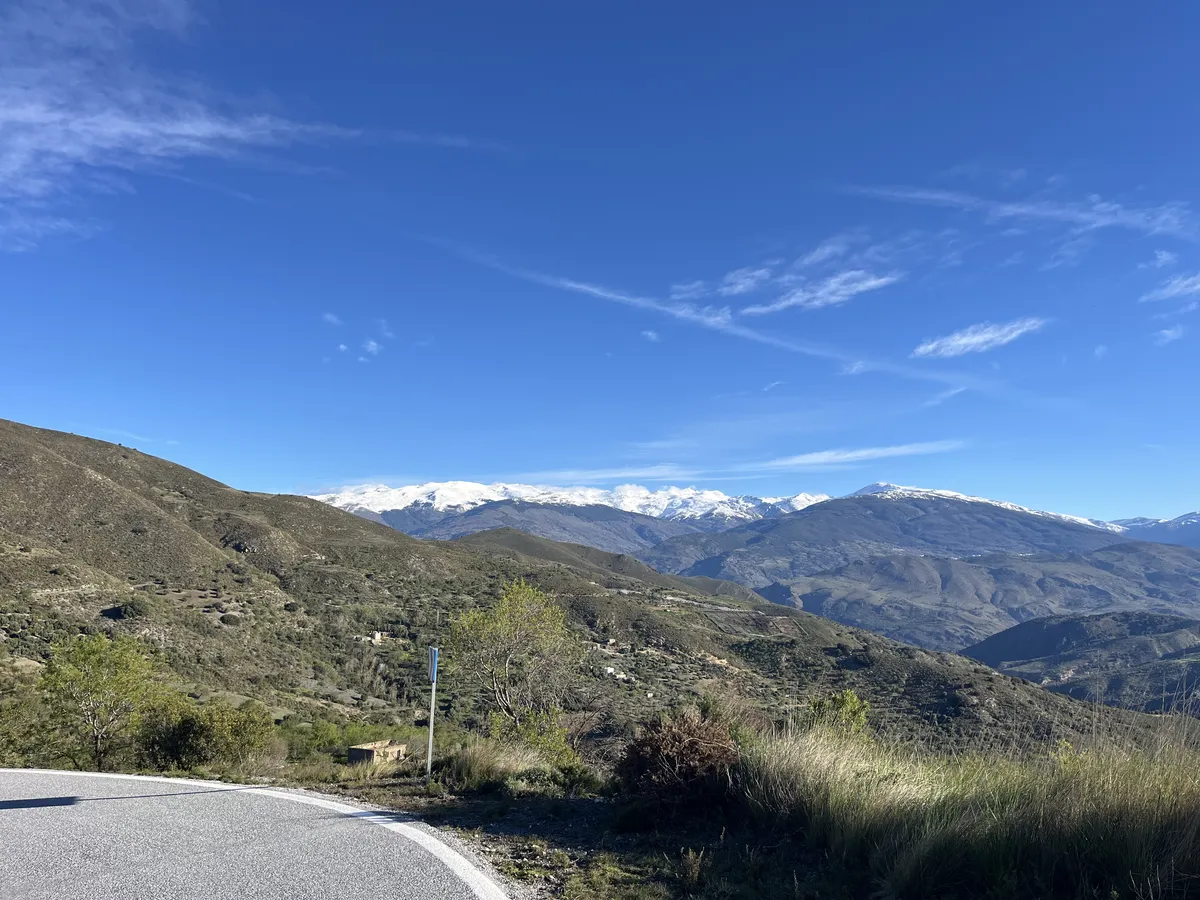
The view was exciting and intimidating in parts. Wow, look, that is the place I am going to be at the end of the day. And: Wow, look, that is the place I am going to be… By the end of the day? I picked up my pace. According to my napkin math I was ahead of schedule and was scheduled to arrive on the summit an hour before sunset.
The silver dry industrial greenhousery of the Castell de Ferro hills was behind me and now I walked through something closer to Lord of the Rings; grand views of sweeping mountains in the distance, little rivers here and there, thick greenery and old trees and quiet villages with old Romanic churches. There were more people here on the streets and they smiled at me. You could see activity from other outdoorsy folk too; plenty of hikers and signs like COTO DE CAZA and COTO DE PESCA indicating places you could go if you wanted to shoot an animal or catch a fish.
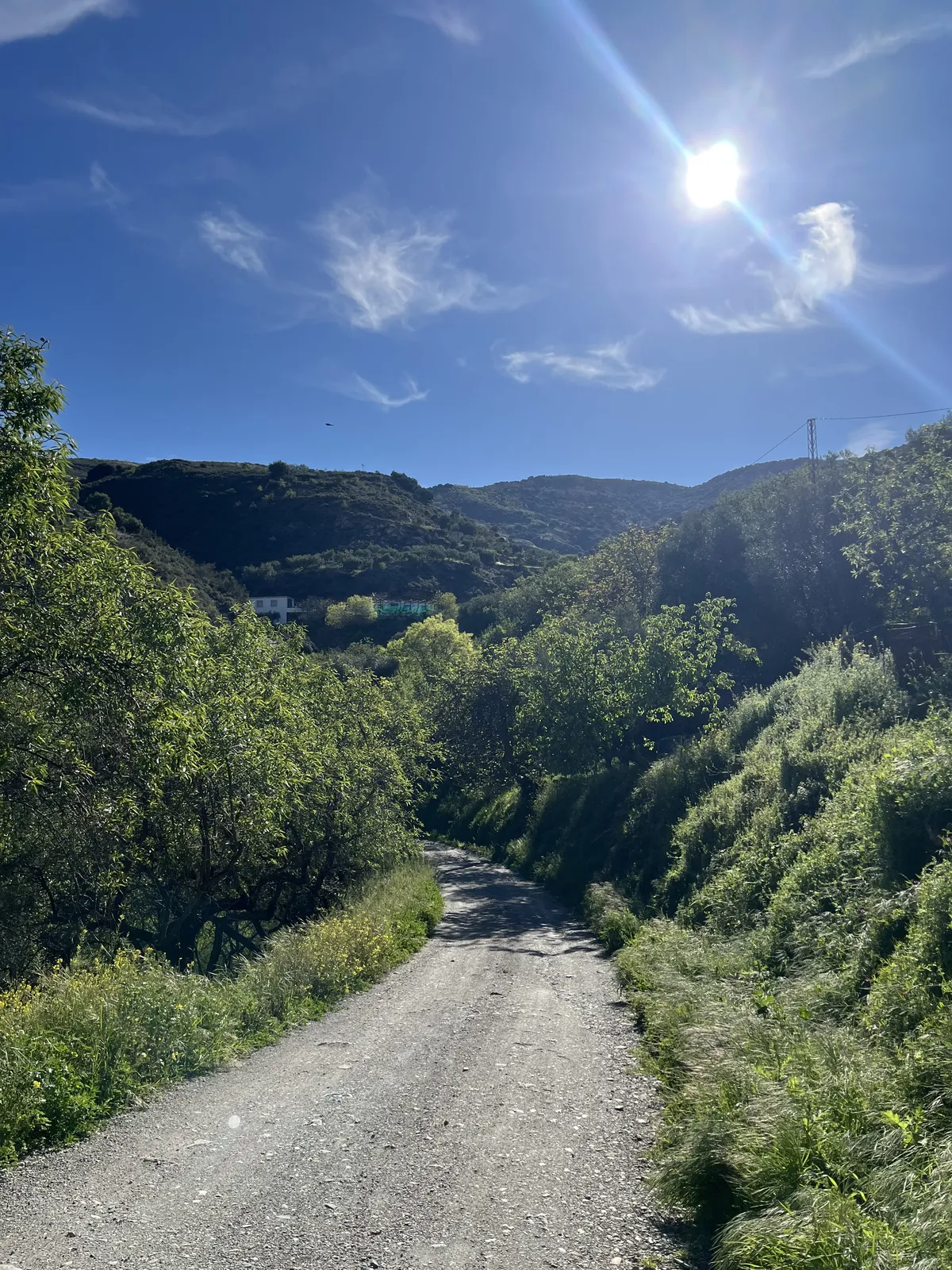
Often when you do exercise for a long amount of time you get into a flow state and that is what happened to me here. The climbs felt like nothing; each step was automatic; I would look down at my phone every so often and realize I had climbed another 1,000 feet or hiked another 5 miles. At this pace it would be easy.
Before long it became afternoon and I stopped in what seemed to be quite a famous little touristic village for lunch. The views were nice, I was on pace. I had a Coca-Cola.
“Where are you headed?” asked an old man in the village as I hiked by.
“Mulhacén,” I said and he laughed. He said something out of earshot.
By the early afternoon I had made more than 20 strong miles and I felt good about progress. But there were a few signs that were conspiring against me. One was the sun. It was April but the sun was quite strong, and 70 degrees is a lot when you are straining to hike as fast as possible. I found myself needing more and more water, and stops to “refuel” and “get some energy” became more frequent. My supply of gummies and other various energy-optimization snacks was running low.
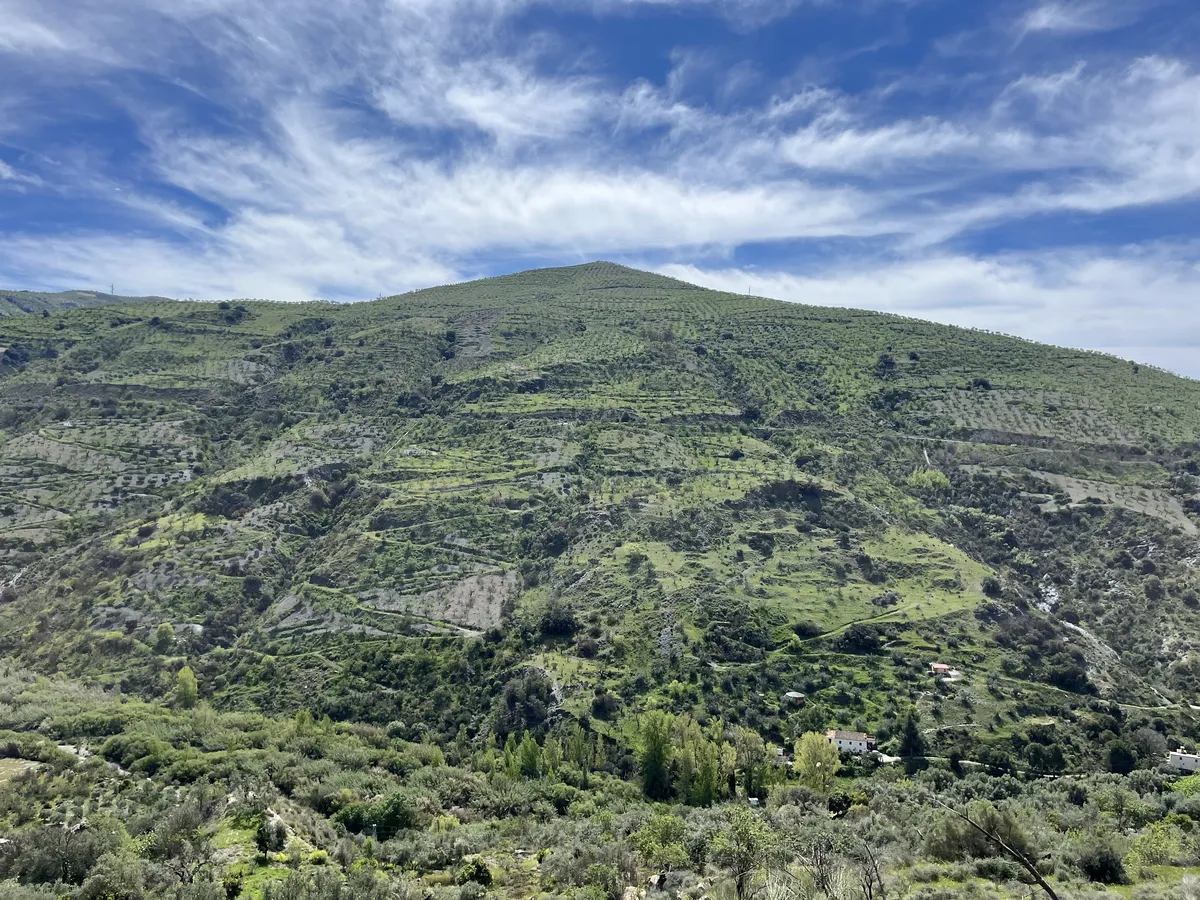
The terrain, too, had become markedly more difficult after this halfway point. I found myself fighting through brush and dense trees where perhaps there had been a trail one point but where clearly nobody had walked in years. Because I was approaching the alpujarra, the dramatic foothills below Mulhacén, the trails were also getting steeper and rockier and more complicated. (Also, I got chased by dogs again.)
The villages over the next few miles were nice. The hiking was not. Everything was rocky and exposed and I found myself stopping every 10 or 15 steps. I started to worry that I was not going to make it on time. This was the first time the doubt had really crept into my mind but it crawled in and made its home. I pushed on.
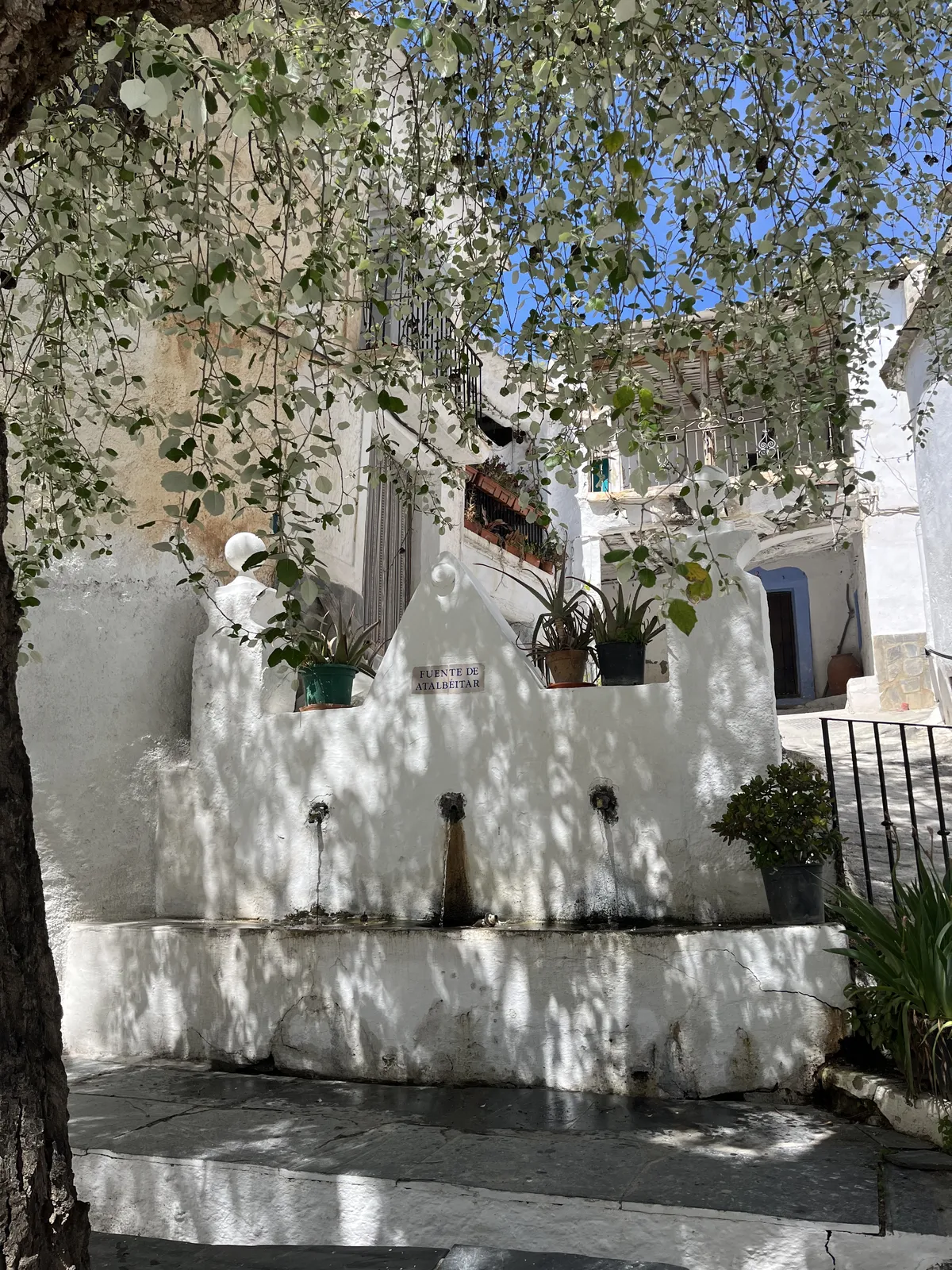
In Pórtugos I took a rest. The village was quiet and sunlight dappled the walls of the houses through spring leaves. I took a seat at a café and ordered a bottle of Coca-Cola. People looked at me and smiled. But the kind of worried smile you give someone to pacify them in case they were thinking of going rabid.
And I continued climbing up to the base of the mountain.
3. Up the mountain
The trails beyond Pórtugos were, as these trails so often are, straight up. And to say I was having a tough time now would be like saying Icarus got just a little bit warm.
The way the sun was beating down, if I had not known the difference I would have thought it was summer. I was exposed, mostly, except for the few times I hiked through groves of short trees. The trails here were not particularly nice, either. I am sure there are nice trails in the Alpujarra but I was not on them. You could tell that sometimes my route intersected with nice paths but on most of this section of the route I found myself thinking: why the hell did people bother to make a trail there?
I descended down into a little river in a deep canyon. I met an unfriendly hiker on my way down and a family at the bottom. Their two little girls were splashing around in a side eddy of the river, calm and clean. It was a good day to be enjoying a river. Their dog ran around the corner and this one was friendlier. I said hello to them as I passed and they waved back. It was funny, the contrast. Here was a family on an excursion (their big event of the day must have been the canyon hike!) and here was I doing whatever the hell you could call what I was doing.
Not too long after the river canyon I started to feel things I had never felt before. On one rocky stretch up a hill I had to resort to staring at the ground to avoid getting discouraged. I would hike for 30 seconds staring at the rocks and then I would stop. Then for 20 seconds. Then for 10 seconds. Then: what is happening to me?
I was only 10 miles from the peak, but I felt a world away.
Both of my knees radiated pain no matter how I moved them. My shin hurt. My sock was wet and red with blood because my shoe had cut into my foot; my backpack had a usually-comfortable hip strap which had cut into my side, so my shirt was bloody too. Moving hurt but so did stopping and so did taking off clothes or putting more on. Damned bloody pack and damned bloody shoes and damned bloody me.
(Before you freak out and tell me how unprepared I was: know that at this stage I was 35 miles in and had climbed more than 10,000 feet of cumulative elevation, in one day. I wager there are very few people on the planet who could describe this as easy; perhaps sherpas in Nepal, and maybe some of the competition-level trail runners. You go try it and then report back to me if you are bloodless and pain-free.)
Then I reached a spot I could only laugh at: the official trailhead most people start at to complete their Mulhacén hike. I still had a few hours until dark. And if I was fresh, this might have been possible. But in the state I was in I knew I would not make it to the peak at dark and, because the mountain was still completely covered in snow, hiking at night would not be safe; I could slip (I did not have an ice ax) and slide down to serious injury. Or I could actually just die.
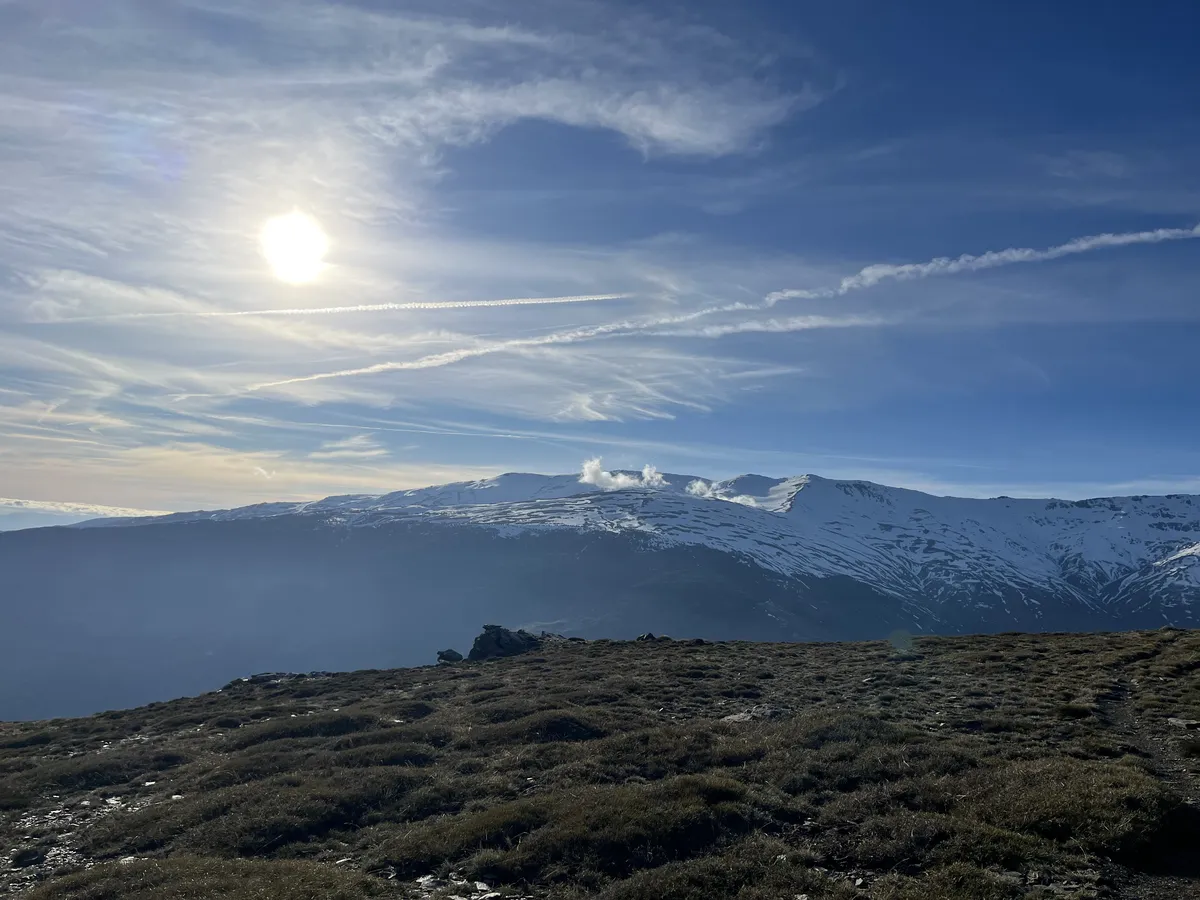
“Is there… any water up here?” I asked a man in the parking lot. It was odd to see a parking lot. The man had driven his daughter up for a day hike along the ridge.
“Um, I don’t think so. Check the bathrooms?”
Eventually I found the faucets at the bathrooms except they were shut for some reason. The bathrooms were closed. How was there no water here? Everything was dry. My mouth was dry. There was no way I was making the final 7 miles tonight.
Still, I had a goal. It had been to reach the top of the mountain in one day. Now I knew that goal was out of reach. But I wanted to get as close as I possibly could; I wanted to be able to know that I had pushed as hard as possible. And if all that was left was a few short miles the next day, I would feel good about myself.
. . .
The final hour to the tent was the most excruciating hour of hiking I have done in my entire life. On one hand there was the demoralization of not achieving the grand ambition. I really had wanted to hit the peak that evening. Oh well.
On the other there was also my body, which was like the body equivalent of a totaled car (sir, it wouldn’t be worth the money to try saving this—get something else).
I had also hit snow. A dirty blanket of white, probably fallen a few weeks ago at the earliest, painted the canvas for as far as I could see in the forest. The hill I began climbing was actually not very step; it was gentler than most of what I had been hiking. And yet I found that every 10 steps I simply could not keep walking. It was not that I was out of breath. My heart was pumping rather calmly. It was that I simply did not have any more energy. Walking straight, or hell, walking downhill would have been difficult. (There is also the fact that I was at around 8,000 feet of elevation and had started the day at 0, which is quite a shift for the body in so few hours.)
Crunch, crunch, breathe in. Crunch, crunch, breathe out. Stop. Rest. Go again.
A few day hikers passed me on the way down. “Good evening,” they said. I rasped something they probably did not respond; perhaps they did not even hear it. Then there was nobody. The trees were there like bars on a prison cell but infinite ones, all the way up into the sky. The snow made things slow.
And then, thirty minutes but only hundreds of steps from the parking lot, I just stopped. I looked at the snow. It was barely sloping upwards. I looked at my legs, and my body, and the blood. And I just laughed. Laughed at everything. Laughed that my body seemed incapable of going up what I would normally be able to sprint up.
In sports this is what they call “bonking,” when your glucose levels are completely used up and your bod does not have more energy to use. When the tank is dry.
But, how? I had planned for this. During the course of the day, calculating back now, I had consumed more than 500g of sugar via various supplements and this was in addition to the protein bars, and the electrolyte liquids, and all of it. I had been forcing myself to consume far more than I thought I would have needed. And, yet, I was bonking. I am sure somebody will have a solution (oh, you should have done X or Y). I don’t really care. The fact of the matter is I was cooked.
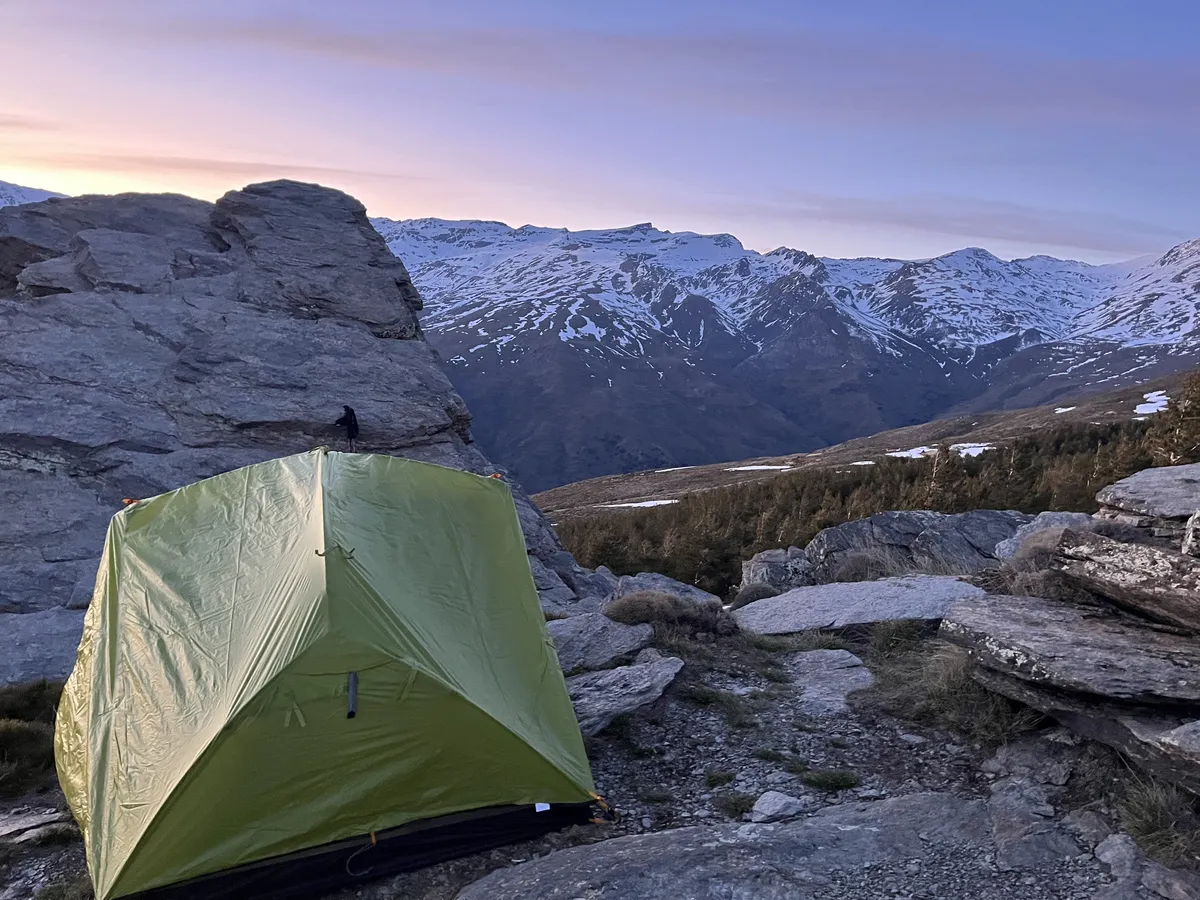
It took me a whole hour to cover the last half-mile to my camp. Then I set up my tent and ate two horrible freeze-dried meals and went to sleep.
. . .
Or at least I tried to sleep. For one thing I could not find a comfortable position. You would think that doesn’t matter if you are so exhausted. It mattered a hell of a lot because everything in my body was screaming pain, the most pain my whole body has ever been in. Alarm bells were going off. My body did not want to let me sleep.
And then there were the foxes.
Before the trip, I had done some reading about the camping situation up on Mulhacén. My searches led me to some small forums where British people who had flown to Spain to hike Mulhacén (why, by the way?) had discussed the dangers of the “very aggressive” foxes in the area. “They will rip into your tent and attack you and take your food,” I read. Browsing local news, I saw that one zone on the mountain had been closed the year prior due to people getting in tangles with foxes. This was all excellent information to have in my head on a night like this one.
My Wendigo, then, my creature from The Willows, my Bogeyman, was not a big scary monster at all. It was little foxes. All night in the tent I thought I heard them. Was that the wind outside the tent, or was it scratching? I didn’t dare check. What would happen if they did get in? The foxes could not kill me, I thought. Then the Other Me said true, but they could bite you and you could get rabies, and then you really would die, and how would you even call for help? You are alone here; it would be too late. You cannot even walk a straight line as it is. I thought about dying and the hairs on my skin prickled up and I wanted to puke. I wanted to puke thinking about rabies and about foxes. I started sweating like when I had been on the trail and my mind conjured all versions of things that could happen to me, and I wanted to puke again, but mostly I just wanted to sleep, why can’t I fucking sleep, please God, let me sleep, but it all hurts, and yes I know all of this is my fault, but still, it hurts so much.
I cast about for my phone and found there was one old podcast downloaded from the film reviewer Mark Kermode. I had not seen half of the movies and I had already listened to the podcast. Who cares. I turned it on and turned up the volume so it was loud enough to drown out the foxes and the rabies and the pain. Some wave of calm, however small, hit me and I was able to close my eyes and forget for a while.
In the morning I felt as though I had not slept at all.
But, good news. There was still a mountain to climb.
. . .
Snow crunched outside my tent.
This time it was not imaginary foxes but groups of hikers making the way up the mountain on a day trip. Then another, and another. After the fourth group of hikers my little isolated tent spot on the edge of nowhere started to feel more like how I’d imagine a homeless person feels camping next to a highway.
So I packed everything up and made my way up the mountain. Everything hurt, but it hurt doubly; there was the pain from the injury and the pain from the soreness. I had done real damage to my knees, which were both red and swollen and could hardly bend. I had also hurt my left ankle, which was still red from the blood but which now had a new kind of red from the swelling. It hardly fit into my left shoe.
But once you start a job like this one you have to finish it and so off I went.
I caught up with the group in front of me. Damn, they looked fresh.
“Want to join us?” one of them said.
“Sure, if you guys don’t mind,” I said.
They talked and I tagged behind like the weak duckling that eventually gets abandoned and dies. Normally I wouldn’t have joined them, I like solitude on the mountain, but I wanted to be near some sort of other human; seeing them walk up and up and up made the hike seem more trivial even with my pain.
“Which way are you guys going up?” I said.
“We do this all the time so today we are trying a more difficult route,” they said.
“Okay. Have fun. Which one is the easy route?”
“Just keep going straight, along the side of the mountain, and when you get to the little mountain hut hook a sharp right and go straight up.”
This was a reassuring route as I could see all of it. Just straight, and then right.
“Thanks,” I said as we parted ways.
One of them looked concerned. “you have all the correct gear, no? Ice axe, helmet, crampons.” What I actually had was some cheap Amazon micro-spikes to go on my trail runners. I did not have a helmet or ice ax.
“But of course,” I said. He frowned as if slightly unsure where I would be hiding that gear in my backpack but seemed satisfied enough, and the crew left their weak ugly injured duckling behind as they went on their quest.
. . .
The final four miles were all steep, and they were all snow. Fortunately it was still cold and so the snow was still hard, and my micro-spikes could crack into it. I could see my breath; the wind was so loud I could not hear. At the steepest part of the snow on the side of the mountain, one of my micro spikes slipped off. I couldn’t risk walking with it half-off, as it compromised stability, so I sat down. It was a 200-foot fall.
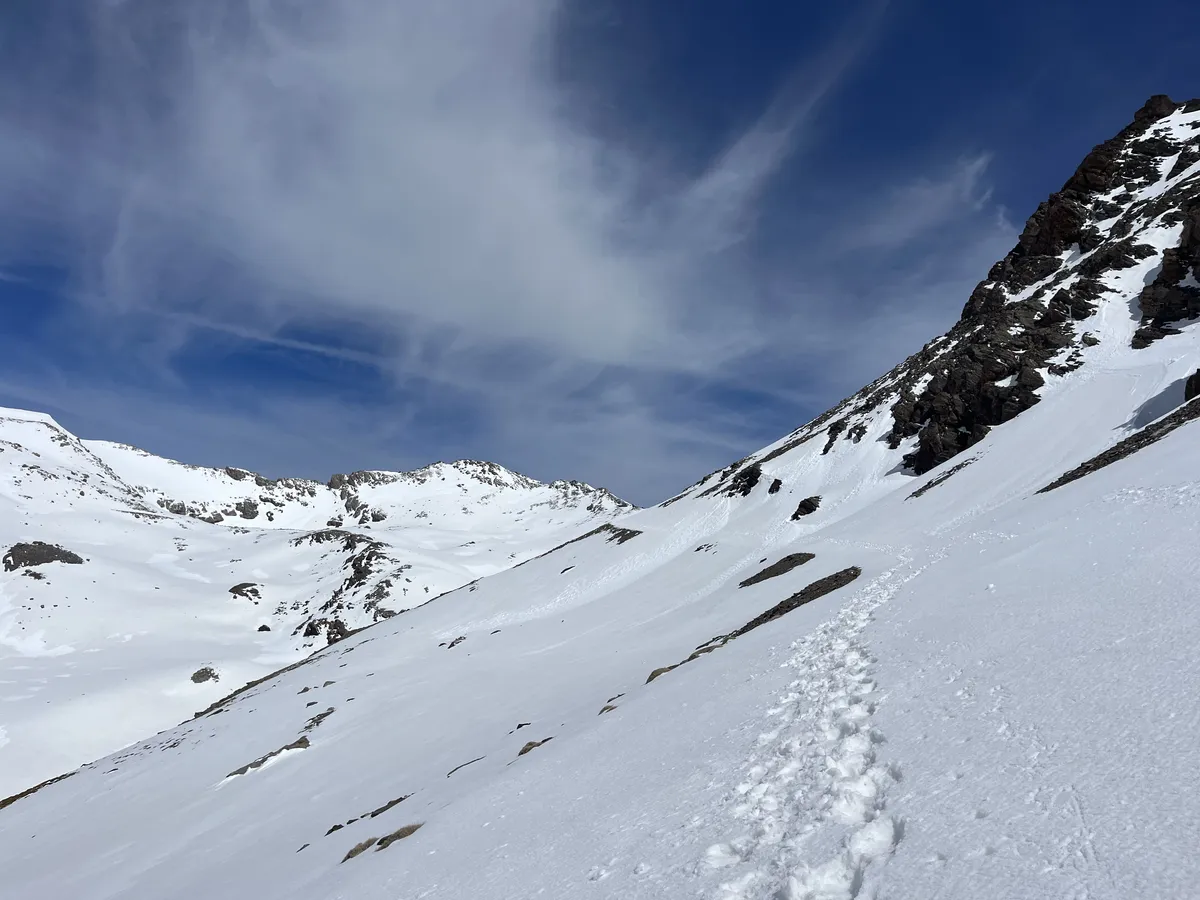
I started sliding down. Shit, shit, shit.
I dug in a hand. Okay, safe now. I inched back up. I started sliding again. Fuck. I inched back up. Eventually I got the micro spike on. There was a man sitting on the little ledge of a trail just 20 feet in front of me, looking scared. I asked him if he was okay and he said yes so I continued on. Eventually he did, too.
In fitting fashion, the last quarter-mile of this hike was the steepest. I would dare say that in the snow it is about the steepest grade you can hike without hiking actually being vertical climbing.
Step by step by step. An hour later, I was at the top. Normally the view would not have impressed me much; it did not impress me much even now. The one thing that did impress me was looking south, because there, I could see the ocean. The ocean.
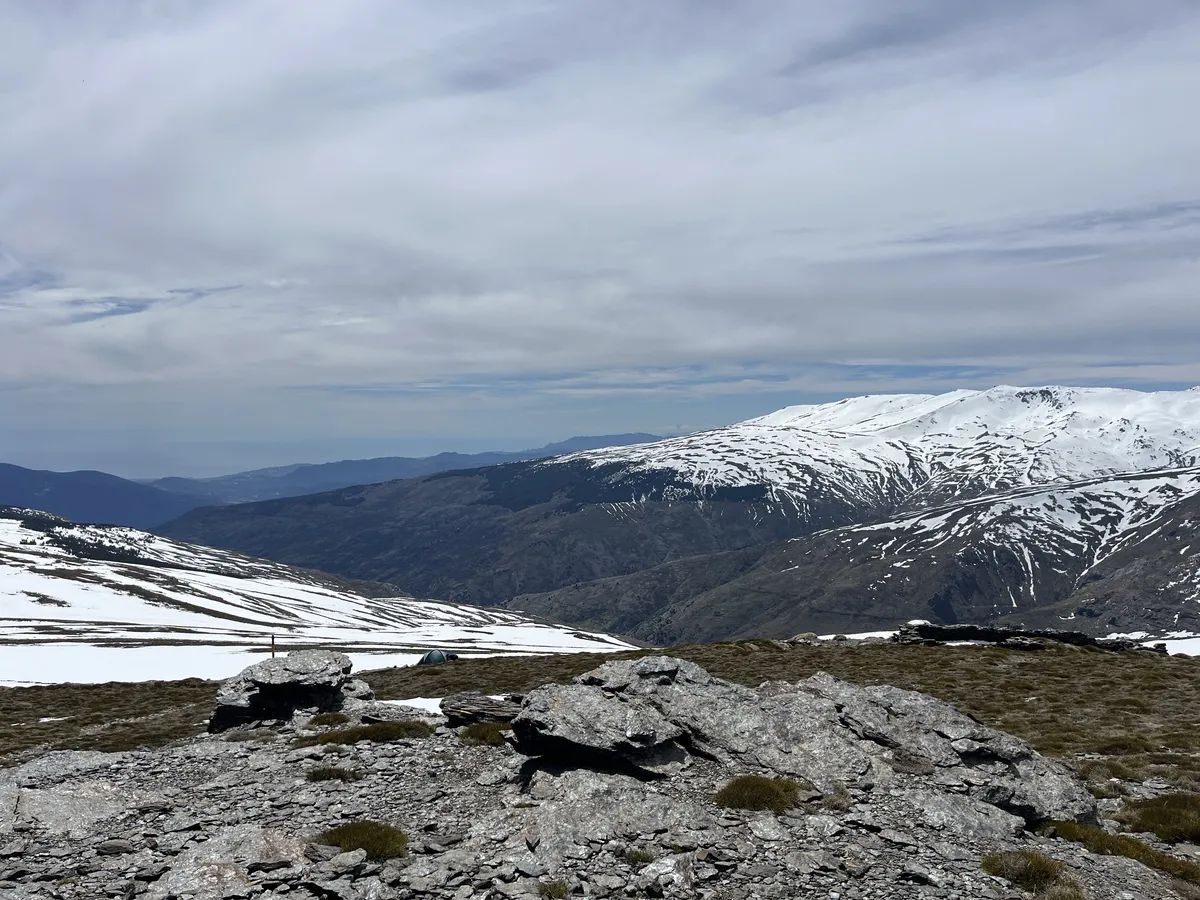
Two guys about my age were up there. “You made it!” they said. They had seen me earlier but blazed past with fresh legs I could only dream of.
“I did.”
“Where did you start?” they asked.
“At the beach.” I pointed to that small blue sliver on the horizon. “There.”
I must confess I had wanted to do this all trip but nobody had ever asked. Finally.
“What?” They looked at each other.
“Yeah.”
“How far is that?”
I told them.
“Shit. How long have you been hiking?”
“Since yesterday.”
“What the fuck?”
We hugged and congratulated each other and parted ways. They gave me some bananas and bars for the road, or rather, the trail. “You need them more than us.”
I had booked a hotel for the evening in a town called Trevelez which was not geographically far but which I was not sure how to get to. I asked around. Nobody knew so I checked my map and charted a course mentally.
The two guys offered to drive me but this had to be finished on foot.
4. And back down again
It was snowy and slippery most of the way down. I won’t bore you with more torture porn of how bad my knees felt. At the bottom in the town of Trevelez the veil in my mind that had been allowing me to move just evaporated. All of a sudden I could not move. Never in my life have I felt such a shift in pain and mobility without anything physically changing; I guess the mission mode in my mind just turned off, the light stopped blinking, the power went out, all dark.
My left knee I could not bend. My right leg was slightly better so I used it to support the pain. I was putting as much weight as I could on both of my trekking poles. I stopped into the first bakery I saw and bought every item I could afford in cash. I cannot imagine how I would have looked or smelled; even in a hiking town this was bad. A girl my age and her mother came into the shop. They smiled in an embarrassed sort of way. They left the shop and started laughing with each other.
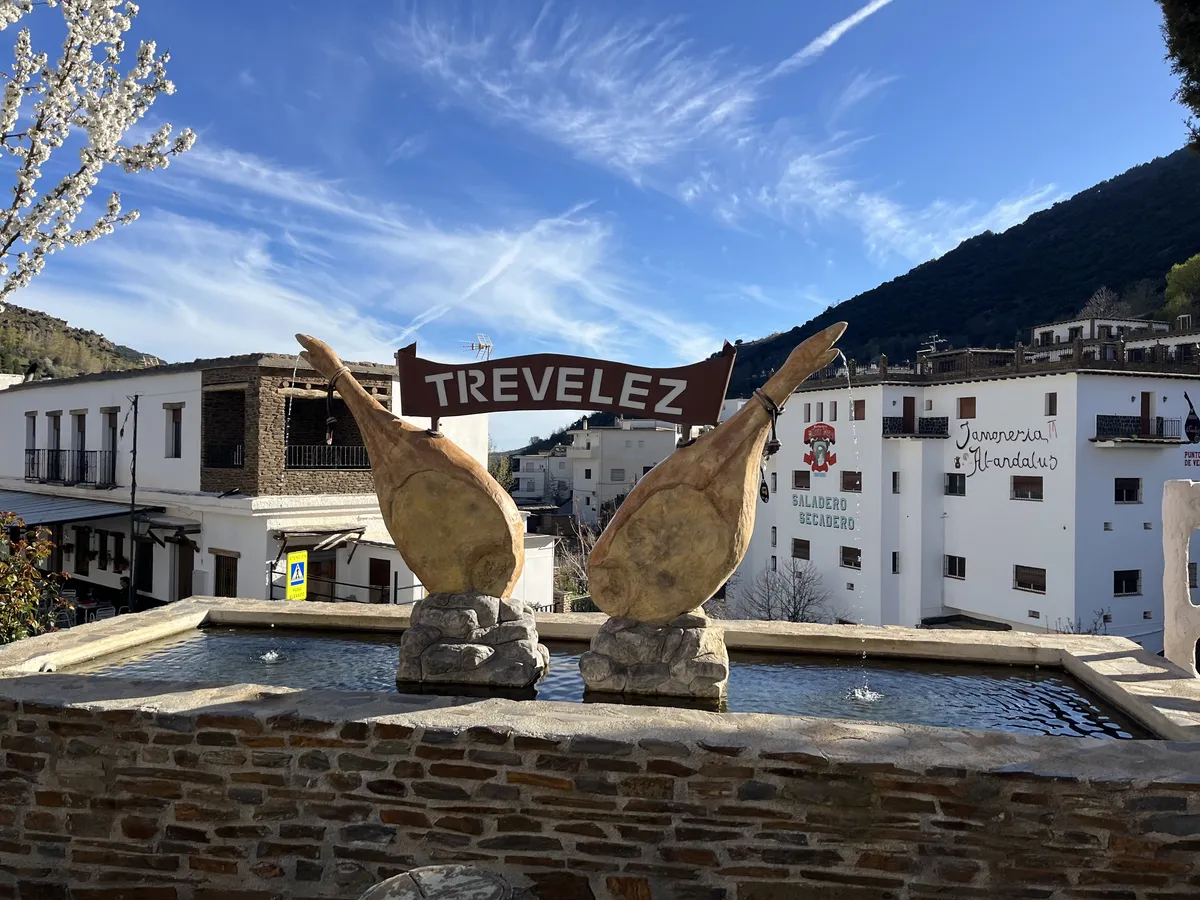
So I hobbled down towards my hotel. I had booked a room with a spacious terrace that looked back up at the mountain. Down here there were plenty of tourists and locals and they were curious about what had put me in such a horrible state.
“Big hike?” they asked.
“Yeah,” I said. “Big hike.”